At a glance
The essentials on medical marijuana reciprocity—what an out-of-state card may allow, what it never permits, and how to travel more safely.
- Reciprocity is not universal. Every state decides whether and how it recognizes medical marijuana cards issued elsewhere.
- Recognition can take several forms. A state may permit purchases, offer temporary visitor registration, recognize possession only, or provide no reciprocity at all.
- An out-of-state card may not be enough. Some states require advance registration, an application fee, a matching qualifying condition, government identification, or approval before visiting a dispensary.
- Reciprocity does not authorize interstate transportation. Never carry or ship marijuana across state lines, even when both states permit medical or adult use.
- Federal locations create additional risks. State medical-marijuana protections generally do not apply on federal property, including federal buildings and many national parks.
- Adult-use access is different from medical reciprocity. Adults 21 or older may be able to purchase in an adult-use state, but an out-of-state medical card may provide no added privileges.
- Florida does not offer reciprocity. Visiting patients cannot use another state’s medical card to purchase from Florida Medical Marijuana Treatment Centers.
- Pennsylvania does not provide general visitor reciprocity. Patients must satisfy Pennsylvania residency, certification, registration, and identification-card requirements to use its medical program.
- Verify the rules before every trip. Check the destination state’s official website and confirm requirements with the specific dispensary before traveling.
- When access is unavailable, do not improvise. Avoid unlicensed sellers, do not transport products from home, and consider going without cannabis during the trip.
If you use medical cannabis and you’re planning a trip, that question can feel stressful. Reciprocity rules are complicated, they change often, and the answers you see online don’t always match what actually happens at the dispensary counter.
This guide walks through how reciprocity works today, which types of states generally accept visiting medical patients, and how to protect yourself legally when you travel. We’ll also explain what this means if you’re a Florida or Pennsylvania patient working with Medcard.com MD.
First, a crucial legal note
Cannabis is still illegal under federal law
Even if your home state has a strong medical program, cannabis remains illegal at the federal level. That means:
- You cannot legally carry cannabis (of any kind) across state lines.
- Shipping cannabis to another state is also illegal.
- Federal land (national parks, some airports, federal buildings, certain military housing) follows federal law, not state law.
Americans for Safe Access’ 2025 travel guide warns that transporting or mailing cannabis across state lines can expose you to federal trafficking penalties, even for small amounts
So reciprocity never means “you can bring your medicine with you wherever you go.” It only affects what happens after you arrive in another state.
What “reciprocity” really means
“Medical cannabis reciprocity” simply means a state is willing to recognize a medical marijuana card issued by another state in some way.
States usually fall into one of four buckets:
- Full access: You can both buy and possess medical cannabis at local dispensaries using your out-of-state card.
- Visitor or temporary cards: You must apply for a short-term “visiting patient” card, usually online, before you can buy products.
- Possession-only recognition: Your card may protect you if you’re found in possession, but you generally can’t buy from local dispensaries.
- No reciprocity: The state ignores your medical card completely. Any legal access will be through adult-use (recreational) laws, if they exist, and only if you’re 21+.
States that commonly recognize out-of-state medical cards
Important disclaimer: Laws change quickly. The examples below are based on late-2025 resources, but you must always confirm with official state sources before you travel.
1. States that generally allow visiting patients to buy and possess
Some states give visiting medical cardholders nearly the same rights as local patients, often with simple ID checks at the dispensary. As of late 2025, states and jurisdictions commonly described as offering full or near-full purchase and possession rights to many out-of-state cardholders include:
- District of Columbia (Washington, DC)
- Maine
- Michigan
- Nevada
- New Mexico
- Rhode Island
- Puerto Rico
- Often also Delaware and Louisiana, which recent guides list as offering broad reciprocity for visiting patients.
Each of these has fine print. For example:
- Some limit which home states they recognize.
- Some require your qualifying condition to match their own list.
- Purchase limits and product types can differ from what you’re used to at home.
- This is why calling ahead to dispensaries in the area you’ll visit is so important.
2. States that offer temporary or visitor medical cards
Several states don’t let you walk in and buy with your home-state card alone. Instead, they require you to apply for a short-term “visiting patient” card or registration, often one to three weeks before you arrive.
States commonly cited in this group include:
- Arkansas – visiting patient card (often up to 90 days).
- Hawaii – online “329V” visitor card for eligible conditions
- Oklahoma – 30-day temporary license for non-residents.
- Mississippi and South Dakota – visitor registration through the state cannabis authority, generally before you travel.
- Utah – 21-day visitor cards with condition-based eligibility.
- New Jersey, New Mexico, and Kentucky, where recent 2024–2025 guides describe structured temporary or reciprocal access processes for non-residents.
In these states, your home-state card is still crucial, but it’s just the first step. You usually need:
- Your valid medical card.
- Matching government ID.
- An online application and small fee.
- Approval notice (often email or printable PDF).
Some states require you to meet their own list of qualifying conditions even if your home state is broader.
3. States that mainly recognize your card for possession only
A third group of states offers limited reciprocity: they may respect your card if you’re stopped by police or found with medical cannabis, but they won’t let you buy from dispensaries as a visitor.
States frequently described in this “possession only” or “limited access” category include:
- Arizona
- Missouri
- New Hampshire
- Georgia (usually low-THC oil only, with strict limits)
- Iowa (restricted products and possession caps)
- West Virginia (very narrow reciprocity, often limited to specific serious conditions like terminal cancer)
This can be especially confusing for patients because:
- You might be “legal” to possess what you already have within that state,
- But you still cannot legally bring cannabis into the state from somewhere else because of federal law.
So, in practice, many patients in these states rely either on local adult-use markets (if legal) or go without, which is why planning matters so much.
What about California, Colorado, Florida, and Pennsylvania?
Many people assume that “cannabis-friendly” states will automatically honor medical cards from everywhere else. That’s not always true.
Adult-use (recreational) states
States like California, Colorado, Oregon, Washington, Massachusetts, Illinois, New York, and others have adult-use cannabis programs. In those states, adults 21 and over with valid ID can usually buy cannabis from licensed recreational dispensaries even without a medical card.
However:
- Your medical card from another state usually does not give you extra benefits.
- You’ll be treated as a recreational customer, not a medical patient.
- That often means higher taxes, different purchase limits, and less medical-focused product guidance.
Florida and Pennsylvania: no reciprocity
By contrast, Florida and Pennsylvania only allow registered medical patients to purchase from licensed dispensaries, and both currently do not offer true medical reciprocity to visitors.
Key points:
- You cannot use another state’s medical card to buy medical cannabis in Florida or Pennsylvania.
- You still cannot legally bring cannabis across state lines into those states.
- Adult-use (recreational) cannabis remains illegal in both states as of late 2025.
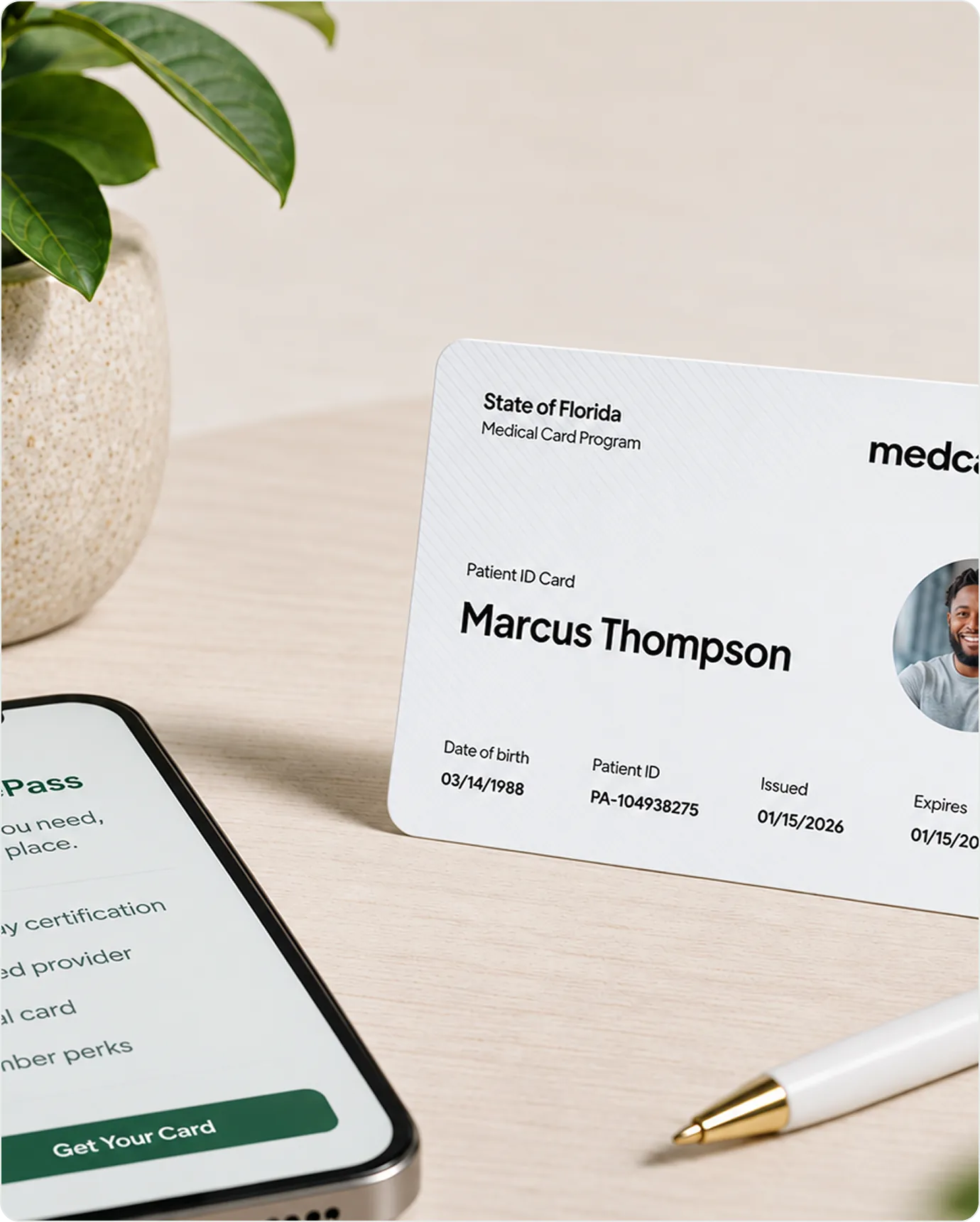
If you live in Florida or Pennsylvania and want legal access to medical cannabis, you need a valid in-state medical certification and card. That’s exactly where Medcard.com MD helps, with quick online evaluations and a clear, ethical process to help you stay compliant.
Why practice can differ from what the law says
Patients who share their experiences online often describe a frustrating reality:
The law might say one thing, but individual dispensaries and staff sometimes do something different.
Common issues people report include:
- Staff are not familiar with reciprocity, even when the state technically allows it.
- Dispensaries choosing, as a matter of company policy, not to serve out-of-state patients even if they’re allowed to.
- Confusion around which home states are recognized, especially in border areas.
The safest approach is to treat every reciprocity list as a starting point, not a guarantee. Always verify with both:
- The state’s official medical cannabis program website, and
- The specific dispensary you plan to visit.
How to check if your medical card will work before you travel
Here’s a simple, practical process you can follow before any trip:
Step 1: Look up the state’s official medical cannabis program
Search for “[State] medical cannabis reciprocity” or “[State] visiting patient medical marijuana.” Many states now host detailed reciprocity pages, for example, Illinois publishes a current list showing which states will accept its patients and what kind of access they get.
Make sure you’re reading:
- A .gov or official health department site, or
- A well-maintained patient advocacy resource that clearly cites state law.
Step 2: Confirm whether you can purchase, possess, or both
Once you find the official information, focus on:
- Whether visiting patients can purchase from dispensaries.
- When a visitor card or temporary registration is required.
- Whether your home state is specifically named as eligible (some states only accept cards from certain states).
Step 3: Call one or two dispensaries at your destination
Even with a favorable law, dispensaries sometimes:
- Require extra documentation.
- Don’t participate in visitor programs.
- Have their own interpretation of ID or residency rules.
A quick phone call or email can save you a wasted trip.
Step 4: Have a backup plan
If you discover that your medical card won’t be accepted where you’re going, consider:
- Whether the state has an adult-use market, you can legally use it as a 21+ adult.
- Whether it’s safer (and legal) to skip cannabis on that trip entirely.
- For longer stays or relocations, consider whether you should pursue a local medical certification in the new state.
- Traveling with medical cannabis: key safety reminders
A few big-picture rules from patient travel experts are worth repeating:
- Do not cross state lines with cannabis. Even if both states are legal, moving cannabis between them is still a federal crime.
- Avoid flying with non-hemp cannabis. TSA focuses on safety, but they must report illegal substances if they find them. Some airports provide “amnesty boxes” to dispose of cannabis before security.
- Know the local rules for possession and consumption. Even in legal states, public use is often restricted, and DUI laws still apply.
- Choose licensed outlets. State-licensed dispensaries must meet testing and labeling requirements that gas-station or online products often do not.
How does Medcard.com MD fit into your travel and access plan?
Medcard.com MD can’t change federal law or state reciprocity rules; no one can. What we can do is make sure your home-state certification is solid, simple, and compliant, so you have the best foundation possible wherever life takes you.
If you’re in Florida or Pennsylvania, we offer:
- Fast, online medical evaluations (around 10 minutes) with licensed doctors and nurse practitioners.
- Ethical, evidence-informed recommendations, no prescriptions, and only when you truly qualify under state rules.
- A money-back guarantee if you don’t get approved.
- 24/7 support so you’re never alone in your medical card journey.
If you’re just starting out, you can begin your healing journey with Get Medical Marijuana Card Now.
If you’re an existing patient, staying ahead of expiration dates with Renew My Med Cardcan help you avoid interruptions in your access.